The May Issue
A 19-look styling editorial built as a content system: a fixed four-chapter taxonomy, a consistent house voice, and a rule set every look has to answer to.
Read the issue →The content behind Eunoia, an intelligent mirror, and how language makes an automated system feel trustworthy, human, and yours.
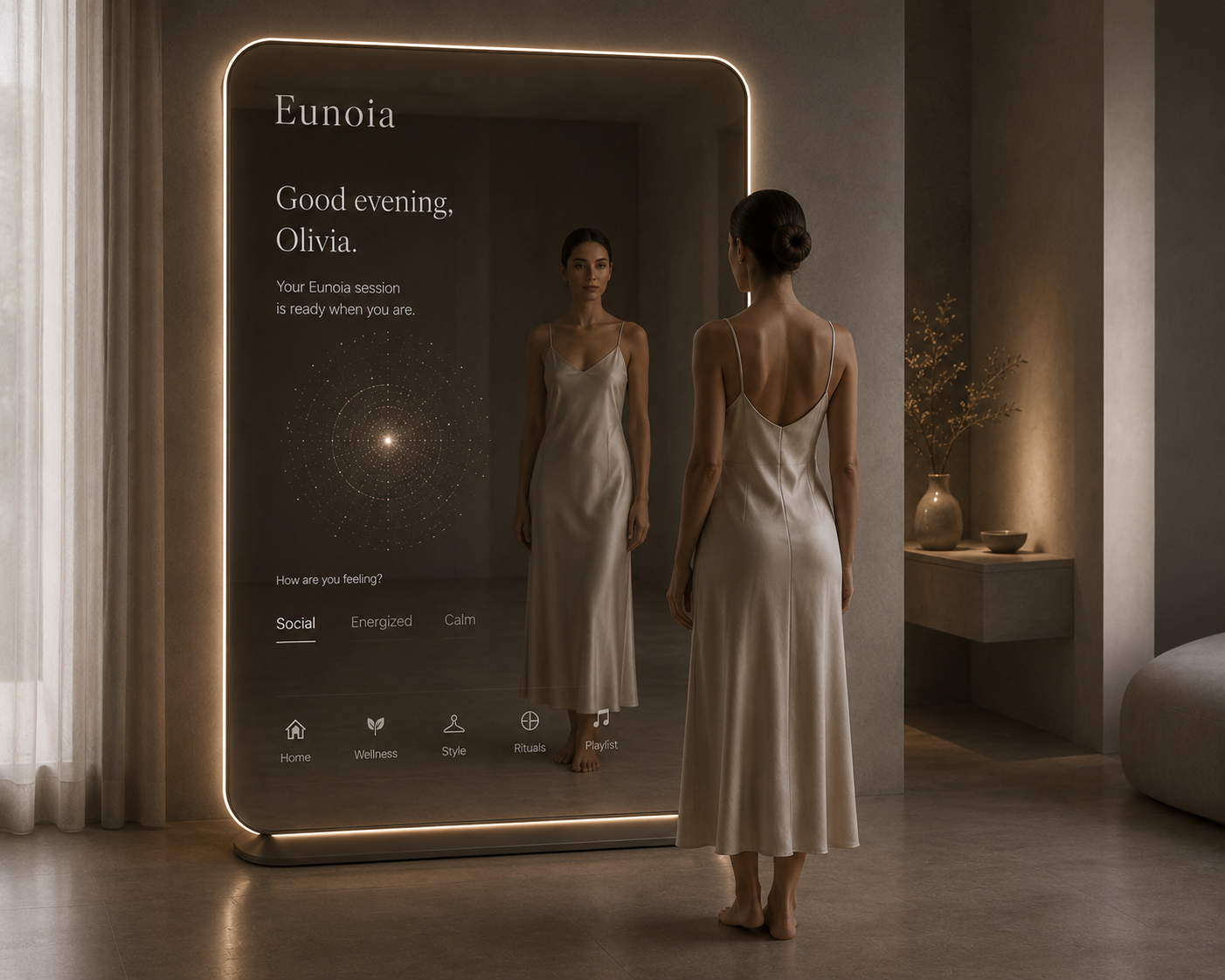
Eunoia is an intelligent mirror that pairs wellness prompts with music, style, and ritual. It suggests outfits, guides small moments of breath and movement, and helps set the tone of a morning.
Like any AI product, its real challenge was not capability. It was whether people would trust it with something as personal as how they show up each day. Most of that trust had to be built in words: how the product introduces itself, explains its choices, and hands control back to the person in front of it. I led the content, and the three decisions below are where that trust was won.
How should a new AI speak before it knows anything about you?
"Eunoia doesn't wait to know you. Early suggestions are thoughtful and considered, so the experience feels intentional from the moment you start."
New AI products apologize for the cold start. "The more you use it, the better it gets" quietly promises someone the first weeks will feel thin and generic, which is exactly when they decide whether to stay.
I wrote the empty state as a promise, not a disclaimer. Eunoia is intentional from day one. Having little data becomes a design stance to stand behind rather than a shortfall to excuse, so the person feels considered before the system has earned it through use.
How do you promise personalization without sounding like a tracking pipeline?
"Eunoia notices when your taste shifts and updates what it surfaces, so nothing ever feels stale."
Most products describe personalization in the language of data: "our algorithm learns your preferences." It is accurate, it is cold, and it puts the machine at the center of a moment that is supposed to be about the person.
I kept the person in front and the system in the background. Eunoia "notices when your taste shifts," the verb of an attentive friend rather than a data process. The benefit is felt, nothing ever feels stale, instead of explained through how the model updates.
How do you offer help with something personal without it feeling like a takeover?
"Eunoia surfaces options, you make the call. Designed to inspire, not automate. The best mornings are still yours to own."
AI copy loves to promise effort removed: "let Eunoia pick your outfit." For something as personal as how you present yourself, that reads less like a gift and more like a quiet threat to take the part you actually enjoy.
This is the keystone. It draws a clear line: the system proposes, the person decides. "Designed to inspire, not automate" is a stated value, not a feature, and it tells someone the AI will never take the part of the ritual that makes it theirs. Every screen after it had to hold that boundary the words set.
Eunoia is a Greek word for beautiful thinking and a state of wellbeing. It gave the product a name that carries its feeling, calm, considered, warm, and set it apart from the clinical vocabulary of smart devices.
I paired the name with a single positioning line to settle what the product is, and is not:
"This isn't a productivity tool, it's a ritual companion."
That one sentence became the test every other decision ran against. Whenever a screen started to feel like a task manager, the words were wrong, and the fix usually lived in the copy before it lived anywhere else.
Most of Eunoia's language lives on a screen. The moments that decide trust are the ones where it has to hold a conversation: a person says something, Eunoia has to understand it, respond, and know what to do when it guesses wrong. Writing a voice is one skill. Designing a dialogue that stays in that voice under pressure is another.
"Morning, Kachy. Want to set the tone for today, or shall I read the room?"
"Big presentation at 10."
"Then let's make it feel easy. I've pulled two looks that read calm and sure, and a two-minute breath to steady the start. The looks, or the breath first?"
"Just the outfit."
"Here are two. The first is quieter, the second a little bolder. Yours to choose."
What's happening here. Eunoia reads "big presentation at 10" as a high-stakes morning, not a fashion request, and answers to the feeling before the task. Every turn ends with one small, optional question that hands the floor back: one offer, one question, the person's move. That rhythm, propose and pause, is how the "you make the call" promise survives an actual conversation instead of only a screen.
The real test of a conversational system is the miss, and two happen constantly: it reads the person wrong, or it hears something it cannot do.
"Neither. Not feeling either of those."
"Fair. Tell me what's off, too formal, wrong color, too much, and I'll pull again. Or open the closet and lead the way."
"What's the weather?"
"That one I don't carry yet. What I can do is set your morning: style, a breath, a little music. Want one of those?"
Most assistants apologize at the miss. "Sorry, I didn't get that" makes the person manage the machine's feelings, and every apology is a quiet reminder that the thing is not quite working. Unrecognized requests dead-end in "I can't help with that."
I designed every miss as a repair, not a failure. A misread asks for the one detail it needs and offers a person-led way out. A request it cannot honor names its edge honestly, then reopens a door it can actually walk through. Even the things Eunoia cannot do leave the person somewhere good, because a dead end is where trust leaks out of a product.
This is content design for an AI product before a single line of marketing exists: the naming, the positioning, the in-product education, the voice, and the conversation design that lets an automated system understand a person and recover when it misreads them. The same problem shows up anywhere AI meets people, in merchant and shopping tools, in support and assistant experiences, in any product that asks someone to trust a recommendation. Words are where that trust is won or lost.
"Eunoia picks the perfect outfit for you."
"Eunoia surfaces options, you make the call. Designed to inspire, not automate."
Why I changed it. "Picks the perfect outfit for you" hands the most personal decision to the machine, which is exactly the part people want to keep. Moving the choice back to the person turned the same feature from a quiet threat into a real offer, and it set the boundary the rest of the product now holds to.
"Join the waitlist"
"Get early access"
Why I changed it. "Join the waitlist" describes a queue you wait in. "Get early access" describes something you receive, and it matches what a limited founding circle actually offers. Same button, but the words move it from a task into an invitation, which is the thing a waitlist is really selling.
The same instincts behind Eunoia, applied to fashion. Each of these is written as a system with its own taxonomy, voice, and decision rules, not a set of one-off pages.
A 19-look styling editorial built as a content system: a fixed four-chapter taxonomy, a consistent house voice, and a rule set every look has to answer to.
Read the issue →A personalized client deliverable structured as a decision system: 23 pieces mapped to budget, occasion, and sourcing, with rule-based head-to-toe pairings.
View the guide →